Project Management & Auditing
Project Management & Auditing
Our PMC services ensure your project runs smoothly. We focus on quality assurance and quality control. This minimizes risks and maximizes efficiency.We provide expert oversight for timelines and budgets.
3rd Party Project Audit
Independent audits for transparency and accountability. We identify potential issues early. Our audits ensure compliance with standards.This safeguards your investment through rigorous checks.
Quality Assurance vs. Quality Control - Quality Assurance (QA)
Focused on preventing defects. An arrangement before construction. Oversees the entire quality process.
Quality Control (QC)
Focused on identifying faults. Selects qualified suppliers and materials. Ensures construction meets standards.
Project Verification QC verifies project requirements. This uses established QA procedures. Our checks guarantee project success and client satisfaction.
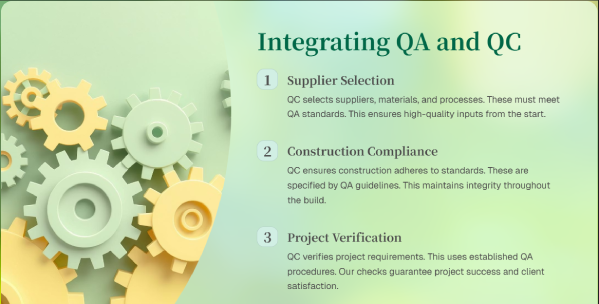
Integrating QA and QC
Supplier Selection
QC selects suppliers, materials, and processes. These must meet QA standards. This ensures high-quality inputs from the start.
Construction Compliance
QC ensures construction adheres to standards. These are specified by QA guidelines. This maintains integrity throughout the build.
Project Verification
QC verifies project requirements. This uses established QA procedures. Our checks guarantee project success and client satisfaction.
yes i am interested
At PHI-Bonacci Design, we provide expert Project Management & Auditing services as part of our multidisciplinary architecture, interior, and engineering consulting portfolio. Our consultancy ensures each project is executed with precision, accountability, and transparency. We monitor timelines, budgets, quality standards, risk factors, and compliance through rigorous auditing processes. From inception through delivery, our project management team implements governance frameworks, progress tracking, performance audits, and corrective action plans to keep projects aligned with client goals. In every engagement, PHI-Bonacci’s Project Management & Auditing approach delivers clarity, quality assurance, and peace of mind—ensuring that design intent becomes reality on schedule and within resource limits.
Project Management & Auditing in Maharashtra
In Maharashtra, PHI-Bonacci Design provides full Project Management & Auditing services to clients in Mumbai, Pune, Nagpur, and beyond. We oversee every stage—from planning and procurement to execution and final review. Our auditors verify cost control, adherence to design specs, risk mitigation, and quality assurance. For Maharashtra projects, we tailor governance and audit protocols to local regulations and site realities. Clients here trust our consultancy to deliver projects that meet vision, quality, timeline, and budget goals.
Project Management & Auditing in West Bengal
In West Bengal, PHI-Bonacci Design acts as the reliable partner for Project Management & Auditing across Kolkata, Howrah, Siliguri, and more. We coordinate contractors, monitor progress, audit cost deviations, review quality, and enforce corrective actions. Our audits include documentation checks, financial reconciliation, and compliance reviews. West Bengal clients rely on us to ensure transparency and keep complex projects on track with rigorous oversight and professional audit standards.
Project Management & Auditing in Madhya Pradesh
Serving Madhya Pradesh (Bhopal, Indore, Jabalpur), PHI-Bonacci Design provides comprehensive Project Management & Auditing support. We maintain dashboards for time, cost, quality metrics, perform periodic audits of site works, materials, contractor claims, and alignment with design standards. Our management ensures that deviations are identified early and corrected. MP clients value our systematic approach, which minimizes waste, enhances accountability, and ensures project integrity.
Project Management & Auditing in Tamil Nadu
In Tamil Nadu—including Chennai, Coimbatore, Madurai—PHI-Bonacci Design offers robust Project Management & Auditing that ensures projects proceed smoothly. We audit vendor deliverables, validate quality levels, monitor schedule slippages, and ensure contract compliance. Our project managers actively coordinate field teams and administrators to execute design intent with fidelity. Tamil Nadu clients engage our services for reliable supervision and audit-backed assurance throughout their construction lifecycle.
Project Management & Auditing in Andhra Pradesh
In Andhra Pradesh—Visakhapatnam, Vijayawada, Guntur—PHI-Bonacci Design offers Project Management & Auditing services tailored to local conditions. We oversee cost tracking, vendor performance, quality inspections, regulatory compliance, and audit trails. Every stage is monitored through checks and balances to avert slippages or cost overruns. Clients in Andhra Pradesh depend on our project auditing to ensure their architectural & interior vision is delivered reliably and responsibly.
Project Management & Auditing in Himachal Pradesh
In the rugged terrains of Himachal Pradesh, PHI-Bonacci Design’s Project Management & Auditing ensures that remote and challenging projects stay on course. We audit structural stability, contractor execution, material quality, and site safety. We adapt audit frequency depending on altitude, access, and seasonal constraints. Himachal clients trust our oversight to bridge design with field realities, ensuring performance under difficult conditions without compromise.
Project Management & Auditing in Uttarakhand
Across Uttarakhand (Dehradun, Haridwar, Rudrapur), PHI-Bonacci Design delivers Project Management & Auditing services to keep every project transparent and on target. Our audits include milestone reviews, budget variance reports, quality checks, and stakeholder reporting. We coordinate contractors, enforce accountability, and guide corrective action. Uttarakhand clients rely on our expertise to prevent scope creep, delays, and budget surprises via audit-backed governance.
Project Management & Auditing in Chhattisgarh
In Chhattisgarh—Raipur, Bilaspur, Durg—PHI-Bonacci Design offers full Project Management & Auditing oversight. Our services include progressive audits, cost reconciliation, vendor management, schedule tracking, and risk mitigation. We maintain strict documentation trails and intervene when deviations occur. Clients in Chhattisgarh choose our consultancy for rigorous oversight, control, and assurance that their architectural vision is executed with integrity and accountability.
Project Management & Auditing in Jharkhand
Serving Jharkhand (Ranchi, Jamshedpur, Bokaro), PHI-Bonacci Design offers refined Project Management & Auditing services to enforce consistency, quality, and cost discipline. We monitor construction progress, audit material usage, validate billing claims, and conduct periodic quality inspections. Our management ensures early detection of divergences and enaction of corrective measures. Jharkhand clients trust our auditing approach to safeguard their investment and ensure design fidelity through execution.
CIVIL PROJECT LIFE CYCLE AND PROJECT MANAGMENT PROCESS
The civil project life cycle and project management process are structured frameworks used to plan, execute, and deliver civil engineering and infrastructure projects (like buildings, roads, bridges, etc.) efficiently. Below is a detailed breakdown of both concepts:
¡ెO'ౌోొj Civil Project Life Cycle (Phases)
This refers to the stages a civil project passes through, from initiation to closure.
- Concept / Initiation Phase
Objective: Identify the need and feasibility of the project. Key Activities:
Client need identification Site selection
Feasibility study (technical, financial, legal, environmental) Budget estimation
Initial stakeholder identification
- Planning & Design Phase
Objective: Develop detailed plans, designs, and documentation. Key Activities:
Surveying and soil testing
Preparation of architectural and engineering drawings Structural, MEP & civil designs
Cost estimation (BoQ)
Approvals from local authorities (municipality, environment, etc.) Scheduling and resource planning
- Procurement Phase
Objective: Source materials, contractors, and equipment. Key Activities:
Tendering and bid evaluation
Selection of contractors/subcontractors
Procurement of materials and equipment Contract signing
- Execution / Construction Phase
Objective: Actual construction of the civil structure. Key Activities:
Site setup and mobilization
Excavation, foundation, superstructure, roofing, MEP installations Quality control and inspections
Daily progress tracking Health & safety compliance
- Monitoring & Control Phase (Overlaps with Execution)
Objective: Ensure project stays on track with respect to scope, cost, and time. Key Activities:
Progress tracking (Gantt charts, MIS reports) Cost control
Risk management Quality assurance
Change order management
- Closing / Handover Phase
Objective: Formal completion and transfer of project to client. Key Activities:
Final inspection and snag list Certification of completion
Handover documentation (drawings, warranties, manuals) Demobilization of site
Client satisfaction check and feedback
ݔ⬛¡|#ݖ Project Management Process (as per PMBOK / PMI)
The Project Management Institute (PMI) outlines the process in 5 process groups, aligned with the life cycle stages.
- Initiation
Define scope and objectives Identify stakeholders
Create project charter
- Planning
Define project scope and WBS (Work Breakdown Structure) Develop time schedule (CPM, Gantt charts)
Prepare budget
Risk management plan Communication and quality plans
- Execution
Assign teams and roles
Direct and manage project work Quality assurance Communication with stakeholders
- Monitoring and Controlling
Monitor progress against plan
Manage changes in scope, schedule, and cost Quality control and performance reporting
Risk monitoring
- Closure
Final audits and inspections Release resources
Archive documents
Conduct project review and lessons learned
⬛“⬛ Key Interactions
Civil Phase | PMBOK Process | Output Initiation Initiating | Feasibility & Charter
Planning & Design Planning | Drawings, BoQ, Schedules Procurement Planning + Executing | Contract Agreements Construction Executing Built Structures
Monitoring Monitoring & Controlling Reports, KPIs Handover & Close Closing, Completion Certificate
ݜ)’c Project Management Tools Used Primavera P6 / MS Project – Scheduling
AutoCAD / Revit / STAAD – Design
MS Excel / ERP / Tally – Costing and accounting BIM Tools – Coordination and clash detection Site Diary / Daily Logs – Execution tracking
Let me know if you’d like a flowchart, PowerPoint slide, or Excel format for this life cycle and PM process.